Overview
What the posture is for, in one or two sentences, plus its category and level so you know where it belongs in a practice.
“A standing posture that builds steadiness, balance and focus.” · standing · intermediate
A proprietary 3D library of traditional yoga poses. Each asana keeps its Sanskrit name and opens into a full study page — a model you can turn in your hand, how to enter the posture, what it offers, what to avoid.

Beyond the shape, each entry carries the practical knowledge a teacher would give you beside the mat — how to get in, what it does, and when to hold back.

What the posture is for, in one or two sentences, plus its category and level so you know where it belongs in a practice.
“A standing posture that builds steadiness, balance and focus.” · standing · intermediate
Joint-by-joint alignment references and the breath pattern that belongs to the posture. Being written now, pose by pose.
The entry, numbered and unhurried — set up, align, then breathe. Three steps you can hold in your head while you move.
Enter the posture slowly with body awareness → align the spine and engage the core gently → maintain steady breathing and visual focus.
What the posture tends to give — awareness, steadiness, release — written as effects on the four bodies, not as promises.
Improves body awareness and alignment · supports calm, steady breathing · reduces physical and mental tension.
The habits that quietly undo the posture, so you can catch them yourself instead of repeating them for months.
Rushing in without a stable setup · holding the breath · forcing range of motion · misaligning knees, hips or shoulders.
When to skip the pose, take support, or choose a gentler variation — injuries, blood pressure, dizziness, an acute back.
Acute ankle or knee injury (use support; avoid unstable balance) · severe dizziness (avoid deep forward folds).
The guidance in the catalog is educational. It is not a medical assessment, and it does not replace a teacher or a clinician who can see your body.
Each asana is a model you can rotate — front, side, back, from above. Look at the far leg, the line of the spine, where the weight actually sits. This is the same model the app loads.
Many postures come in several forms. Pakshásana has four — A to D — each modelled on its own, so you can study the version your body is ready for.
Each posture keeps the name it was given — pakshásana, sukhásana, natarájásana — with the transliteration you can actually pronounce.
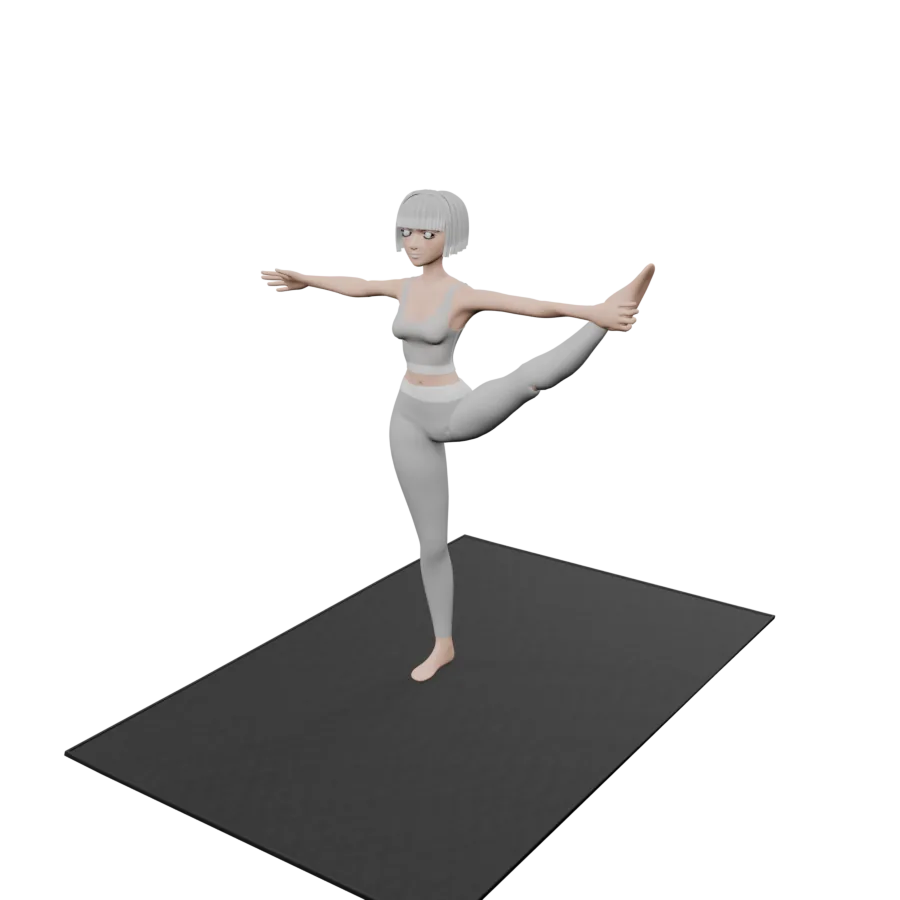
Drag to turn the pose
Every asana is hand-posed on a rigged 3D model, joint by joint, and rendered for the app. No stock photos, no traced illustrations — a library built from the ground up so the alignment you see is the alignment you practice.

The catalog ships with fourbodies — alongside Classes, Breathings, Meditations, Soundscapes and Daily State.
Download on App Store